

News & Events
Just Diagnosed with Multiple Myeloma? One Patient Shares What He’s Learned

John thought he had more time. He had been living with smoldering multiple myeloma for about nine months and knew it could eventually progress to active myeloma. He just didn’t expect it to happen anytime soon.
Fresh off a four-month trip through Asia, John and his girlfriend, Jane, were already planning their next adventure to celebrate his 60th birthday. Instead, a follow-up appointment and further testing brought unexpected news: His smoldering multiple myeloma had progressed to active disease.
“They found two tiny lesions on my pelvis, and that’s when I realized that this wasn’t smoldering anymore. It was actually multiple myeloma and treatment needed to begin right away,” John said. “We were knocked back.”
His travel plans were replaced with a whirlwind of scans, biopsies, decisions, and unfamiliar medical terms. “There were a lot of emotions,” John remembered, “and not a lot of understanding of what was next.”
Many newly diagnosed patients have the same questions and sense of uncertainty that John did. Here’s what he’s learned, and what you can do to better understand your diagnosis, build a care team, prepare for treatment, and find support.
Understanding your multiple myeloma diagnosis
The path to a multiple myeloma diagnosis is different for every patient. Some, like John, are first diagnosed with a precursor condition, such as monoclonal gammopathy of undetermined significance (MGUS) or SMM, and are monitored for signs that it has become active. Others spend months or years seeking answers for unexplained symptoms or learn they have multiple myeloma through routine bloodwork. That’s why it’s important to understand not only your diagnosis, but what it means for you going forward.
When you’re newly diagnosed with multiple myeloma, you’ll learn several important details about your disease that help guide your care. This will include how aggressive your disease might be (which is determined by whether your myeloma is considered high-risk) and how you might respond to treatment.
4 steps to take after you’ve been diagnosed with multiple myeloma
In the days and weeks after you’re diagnosed with multiple myeloma, you’re not just adjusting to your new reality. You’re taking in loads of new information and making critical decisions. The MMRF’s newly diagnosed patient toolkit is a resource you can turn to again and again as questions come up.
After a diagnosis, you can also feel more empowered by taking these four key steps.
1. Build the right team
Like many patients, John was initially diagnosed by an oncologist. He sought a second opinion, which led him to a hematologist-oncologist with a specialty in multiple myeloma.
“The specialty is important because multiple myeloma is rare,” he said. The disease accounts for fewer than 2 percent of all cancers worldwide, so many doctors have limited experience with it.
John added: “Multiple myeloma specialists have seen hundreds of patients with this disease over the years, and that gives them a rhythm for caring for this population.”
As a Chicago resident, John was fortunate to live near a major academic center with a multiple myeloma specialist. Not everyone has that advantage, though. If you’re having trouble locating a specialist, the MMRF’s Find a Specialist tool can help you see if there’s one near you or find one to meet with via telehealth.
Even if you receive most of your care from a local hematologist-oncologist or medical oncologist, it is important to consult a specialist if possible for a second opinion on your diagnosis and treatment plan, as well as at important points in your journey going forward (such as what to do if your disease comes back after treatment, which is known as relapse). It is also common for multiple myeloma specialists to consult with local oncologists or hematologists who deliver your care.
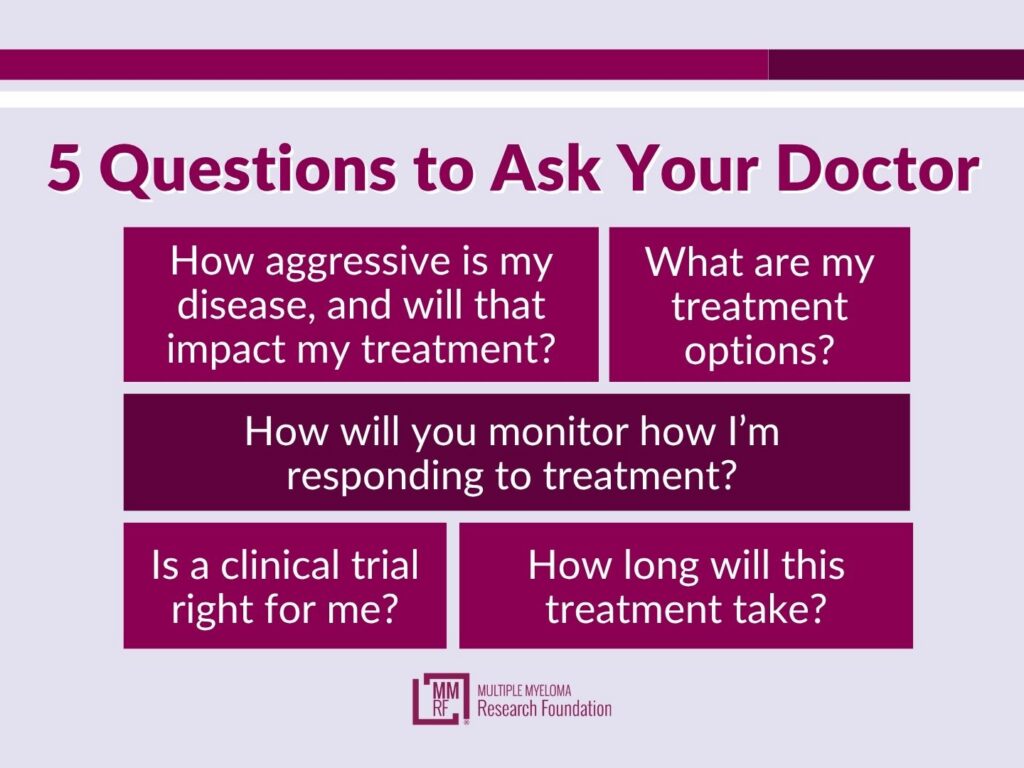
Coming to appointments with a written list of questions can help you better understand your diagnosis and make informed decisions about your care.
Your care team goes beyond a multiple myeloma specialist or oncologist. You may also work with a:
- Nurse practitioner and/or a physician assistant who can answer your questions
- Infusion nurse who will administer your treatment
- Nurse coordinator who can provide care for certain symptoms and share concerns with the rest of the team
- Social worker who can help you access extra support, such as childcare, financial aid, and transportation during treatment
- A center-based patient navigator who can help you coordinate your appointments and care
- Dietitian or nutritionist who can manage dietary concerns during treatment
John also found it helpful to speak with a member of the MMRF Patient Navigation Center. The MMRF’s patient navigators are all former oncology nurses with specialized certifications in patient navigation who are available to talk about your diagnosis, tests, care team, and treatment options. This service is free and confidential.
2. Have the right tests and monitoring
Routine monitoring is a normal part of living with multiple myeloma. For John, regular blood work and follow-up testing showed that his smoldering multiple myeloma had become active disease and that he needed to start treatment right away.
After treatment begins, your care team will continue monitoring your disease through a variety of tests. This data can help your doctor see how well treatment is working, watch out for side effects, and determine whether your plan needs to be adjusted.
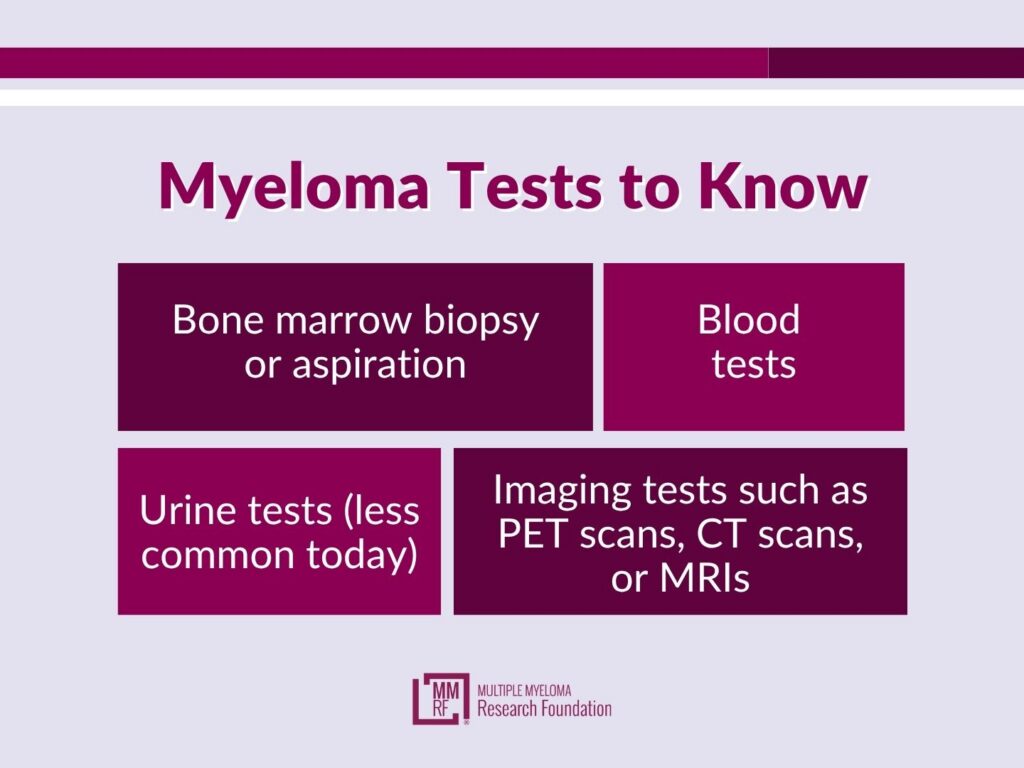
Learn more about tests used in multiple myeloma in our Understanding Your Test Results toolkit.
3. Get the right treatment
Because of research, there has been remarkable progress in multiple myeloma—to the point that a small subset of patients are now considered cured. Today, there are more than 15 FDA-approved treatments that can help patients manage the disease.
The standard treatment approach for newly diagnosed patients starts with induction therapy, which is typically a combination of four anti-myeloma drugs for several months. Many patients then receive high-dose chemotherapy followed by autologous stem cell transplant (ASCT), but not everyone is eligible for a stem cell transplant or can access it.
After you’ve had induction therapy or ASCT, you will transition to maintenance therapy with medication. This can be done through pills, injections, or infusions. Maintenance therapy helps keep the disease at bay (remission) and lowers the risk of it coming back (relapse).
Treatment doesn’t always follow a predictable timeline. John learned that firsthand when his first stem cell harvest collected fewer cells than his care team wanted. With his doctor’s recommendation, he pushed back chemotherapy and ASCT so he could undergo a second stem cell harvest.
“I really wasn’t physically or psychologically ready to go straight into chemotherapy,” John says. The break gave his body time to recover from months of treatment. He even squeezed in a cruise, which helped him mentally recharge before moving on to the next phase.
Learn more about how multiple myeloma is treated in our Treatment Overview toolkit.
4. Find your community
A multiple myeloma diagnosis can feel isolating, but you don’t have to go through it alone. Family members, friends, and partners often provide support as you cope with your diagnosis and undergo treatment. In John’s case, his girlfriend became an essential part of his team. Jane attended appointments with him, took detailed notes on her laptop, researched the disease, and encouraged him to seek a second opinion from a multiple myeloma specialist.
“There are a lot of things thrown at you when you’re diagnosed. Just having somebody with you can make a big difference,” John said. “And hopefully they’re a good notetaker.”
Connecting with people who understand what you’re going through can provide emotional support, practical advice, and reassurance, as well. John found it especially helpful to join a peer support group, which you can find through the MMRF.
Sometimes it’s easier to connect one-on-one. The MMRF’s Myeloma Mentors® program can pair you with a mentor who’s living with multiple myeloma and can walk you through their experiences over the phone.
Navigating what’s next with multiple myeloma
John’s still early in his treatment journey. In the summer of 2026, he was preparing for his second stem cell harvest and was scheduled to receive high-dose chemotherapy followed by a stem cell transplant. He knows the road ahead is long, but he’s taking it day by day and leaning on the support of Jane and his care team.
“Multiple myeloma is a marathon, and you have to get in the pace and cadence of dealing with it,” he says. “But it’s important to remember that it doesn’t define you.”
Common questions after a multiple myeloma diagnosis
What is multiple myeloma?
Multiple myeloma is a blood cancer of the plasma cells found in bone marrow. The disease causes cancerous cells to grow out of control, crowding out healthy white and red blood cells and platelets. While multiple myeloma can affect anyone, it’s more common among men, Black people, Hispanic people, adults age 65 or older, and those whose first-degree relatives had myeloma.
Is multiple myeloma curable?
For most multiple myeloma patients, the disease is not yet considered cured. However, treatments have improved significantly over the last 20 years, helping extend life expectancy, reduce symptoms, and improve outcomes for patients. There are more than 15 FDA-approved therapies for multiple myeloma, with new ones coming out each year that may be curing a subset of patients.
What kind of doctor should I see for multiple myeloma?
See a multiple myeloma specialist, if possible. These doctors treat myeloma every day and stay up to date on the latest treatments. If you can’t see one regularly, you can receive treatment from a hematologist-oncologist or medical oncologist and consult with a myeloma specialist at key points, such as after your diagnosis or if your myeloma comes back (relapse).
How quickly do I need to start treatment after a myeloma diagnosis?
If you have active multiple myeloma, your doctor may want you to begin treatment as soon as possible after your diagnosis.
Some people are diagnosed with precursor conditions, such as MGUS or smoldering multiple myeloma, that don’t need always treatment right away. Instead, your doctor will monitor you closely and start treatment if the disease progresses.
What questions should I ask my doctor after a myeloma diagnosis?
You should ask your doctor what treatment options are available to you, how long treatment will take, and how aggressive the disease is. It could also be worth asking them about whether there are any clinical trials that are appropriate for you to consider, such as the Horizon Two clinical trial for newly diagnosed patients that is run by the MMRF’s clinical research subsidiary, the Multiple Myeloma Research Consortium.
Where can I find support after a multiple myeloma diagnosis?
The MMRF offers free educational programming and support through its Education Resource Hub and Patient Navigation Center (PNC). The PNC can also help you find myeloma mentors, support groups, financial aid for medication, and transportation to treatment.
Do I need a second opinion on my myeloma?
Most patients benefit from getting a second opinion. Even if you’re already seeing a multiple myeloma specialist, a different specialist can review your diagnosis and treatment plan before you start treatment or make a major change. This can help you better understand your options and feel more confident moving forward.