
News & Events
The Myeloma Community Just Proposed the Definition of a Cure. Here’s What You Need to Know.
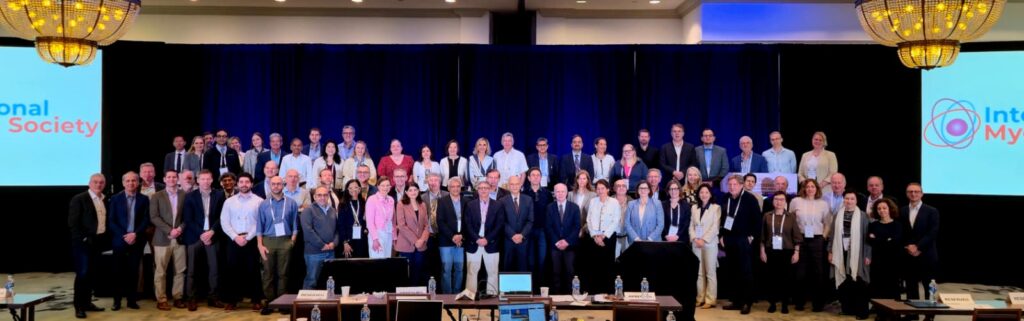
Last week, the International Myeloma Society (IMS) convened a historic meeting to answer a question our community has asked for decades: What does “cure” mean in multiple myeloma?
Over a day and a half, MMRF representatives and nearly 100 clinicians, researchers, industry partners, patient advocates, and patients came together in person, with more than 1,000 participating virtually. Together, we reviewed data spanning more than 30 years—the advent of Total Therapy pioneered at the University of Arkansas in the 1990s through today’s most advanced immunotherapies—to understand what depth and duration of response may truly predict long-term remission and cure.
Based on this meeting, the new proposed definition of a cure for multiple myeloma is:
Patients who are MRD-negative (meaning there are no myeloma cells detected among 1,000,000 plasma cells) and have been off all anti-myeloma therapy for five years may be considered cured.
This marks a profound shift for myeloma research and care.
Cure—Without Compromise
To create a proposed definition, attendees discussed three essential criteria for a cure:
- Effective therapy of finite duration
- No evidence of disease
- No relapse after stopping therapy
For years, continuous therapy has been the standard paradigm, with many patients on treatment indefinitely. But a cure means something fundamentally different and more patient-centered: no detectable disease and no need for ongoing treatment.
Importantly, this proposed definition applies to all patients: newly diagnosed or heavily pretreated, standard-risk or high-risk. Cure, we all agreed, should mean the same thing for every myeloma patient.
One critical caveat: Attendees agreed that cure cannot come at the expense of irreversible side effects or second cancers. Patients should expect not only freedom from myeloma, but to have a normal life expectancy and quality of life.
Defining cure is a watershed moment. Yet today, very few patients meet this five-year, treatment-free benchmark. That reality underscores how much work remains.
Powerful Patient Stories
The most inspiring moments at the meeting came from two extraordinary patients.
One underwent an allogeneic transplant more than 30 years ago and remains disease-free today. The other participated in the CARTITUDE-1 trial of the CAR T-cell therapy Carvykti® and has been off treatment for over seven years with no evidence of disease.
Their experiences and those of other long-term survivors remind us that cure is no longer theoretical—it is possible.
Meeting attendees also heard from leaders in lymphoma, testicular cancer, and lung cancer, where “cure” is already part of the standard vocabulary. Their frameworks helped inform the discussion of what this means for myeloma patients and for the design of clinical trials aiming to test cures.
The Roadmap to Cure
The MMRF is committed to leading the next chapter of this work. Our Foundation’s key priorities include:
- Identifying which current and emerging therapies have curative potential
- Understanding which patients are most likely to be cured with specific treatments
- Matching the right patient to the right potentially curative therapy
- Developing new options for patients who are unlikely to be cured with today’s treatments
- Ensuring curative strategies do not create unacceptable long-term risks
- Studying patients who live treatment-free with low-level disease (such as those reverting to an MGUS-like state)
- Advancing blood-based MRD testing to reduce reliance on bone marrow biopsies
Earlier this year, the MMRF launched the first study in our Translational Research Umbrella (TRU) program, enrolling 150 patients receiving BCMA-targeted CAR T-cell or bispecific antibody therapies as part of standard care. By deeply analyzing tumor biology, immune response, and the microbiome, we aim to understand who benefits most—including who may be cured—and why.
Importantly, gleaning insights into why some people can be considered cured will inform faster, better-designed clinical trials of potential curative treatments. Through our Horizon Clinical Trials Program, we will soon launch additional studies specifically designed with curative intent, building on insights from TRU.
A Historic Moment
For more than 25 years, the MMRF’s mission has been to accelerate a cure for every patient. For much of that time, “cure” felt aspirational. Our focus was ensuring patients lived longer, with new therapies always on the horizon, while we worked to better understand the biology of the disease.
Today, we stand at a turning point. Cure is no longer just a hope. It is an achievable goal.
But achieving it for every patient will require urgency, collaboration, and relentless focus. The MMRF will continue to lead and partner across the community until cure is not the exception, but the expectation—and until we can close our doors because our work is done.
What Myeloma Patients Need to Know Now: Answers to Frequently Ask Questions About the Definition of a Cure for Myeloma
Below, the MMRF team answers several questions we’re hearing from myeloma patients about this proposed definition.
1. How does this proposed definition become official? What happens now?
The International Myeloma Society (IMS) is a society that brings myeloma professionals, industry, researchers, and clinicians together to improve care and promote research. IMS convened this summit to establish a working consensus on a definition of cure in myeloma.
Now that IMS has settled on an official definition, it will help guide research moving forward, particularly when it comes to measuring who has an exceptional response to treatment and why. The field will also move toward standardized MRD testing.
It’s important to note that this definition—based on how other cancers define cure—may evolve over time as we learn more about the disease.
2. I was told multiple myeloma couldn’t be cured. What changed?
Two main factors influenced this definition:
- The field now has long-term data showing that a small set of myeloma patients are living for five or more years off all treatment. This conforms to the definition of cure in other cancers.
- The number of patients who meet this definition is small and they have been treated with various regimens over the years. But with the increasing use of CAR T-cell therapy in myeloma, researchers and clinicians are now seeing more patients who fit this definition and have received the same therapy.
3. How many myeloma patients might meet this definition of cure today?
Very few myeloma patients meet this definition of a cure today. But because of current and future transformative therapies, we expect that number to increase significantly in the coming years.
4. Does this proposed definition change myeloma care today?
It does not change myeloma care today, but it will likely change care in the coming years.
While the field has defined a cure for myeloma for the first time, the fact remains that unfortunately, we do not yet know how to cure every patient, and this definition only applies to a small number of people.
This definition reinforces the urgency of the MMRF’s mission and the need for more research to understand myeloma, uncover differences between myeloma patients and how they respond to treatments, and personalize care. The MMRF’s groundbreaking clinical trials and data initiatives will push the field forward toward a future where every patient is matched to a curative treatment.
If you think you meet this new definition of a cure or have other questions about your individual situation, talk to your myeloma specialist.
5. What happens if a patient meets the definition of cure and then relapses?
When a cured myeloma patient relapses, they will need treatment. This is an unfortunate reality in even the most curable cancers, such as early-stage breast cancers, thyroid and prostate cancers, and melanoma. This is called recurrence. Ongoing research is uncovering why this happens and what can be done to reduce recurrence.
This is why continued research into myeloma is so important. By better understanding the biology of myeloma and how it behaves in different patients, we can optimally treat each patient based on their individual characteristics and recurrence risk.
Further, with more data and research, this initial definition of a cure may evolve over time.
6. How does having a definition of cure change myeloma research? Could this reduce myeloma research funding or slow down drug development?
This is an exciting development for myeloma research. Having a universal definition of cure for the disease will allow researchers to test whether treatments like CAR T-cell therapy are actually curative and generate more data to help us understand who they are curative for and why.
Myeloma research and the MMRF’s research focus has never been more critical. Even if a small number of patients can currently be considered cured, we cannot predict who will be cured or what treatment will lead to cure, especially since those patients have received a variety of regimens.
Patients need more options. The myeloma research community and the MMRF will continue its urgent work to expand treatment options, better understand the disease, and identify curative therapies for every patient.
7. Does this definition apply to smoldering multiple myeloma?
Yes. This definition applies to every patient including those with smoldering multiple myeloma, those who are newly diagnosed, those who have relapse/refractory myeloma, and more.