

News & Events
Making Sense of MRD: One Tool for Monitoring Myeloma

When treatment for multiple myeloma is working well, it can eliminate most of the myeloma cells in your body. At that point, a very small number of cells may remain at levels that are too low for standard tests to pick up.
That’s why your doctor may suggest testing for MRD, or minimal residual disease. This highly sensitive test can detect myeloma cells that other tests may miss, giving your care team a more precise look at how your treatment is performing.
While MRD testing is a helpful tool, it’s important to talk to your care team about what the results mean for you. Here’s what to know about MRD in myeloma, what it means to be MRD negative, and how disease monitoring can help you better understand the road ahead.
What is MRD?
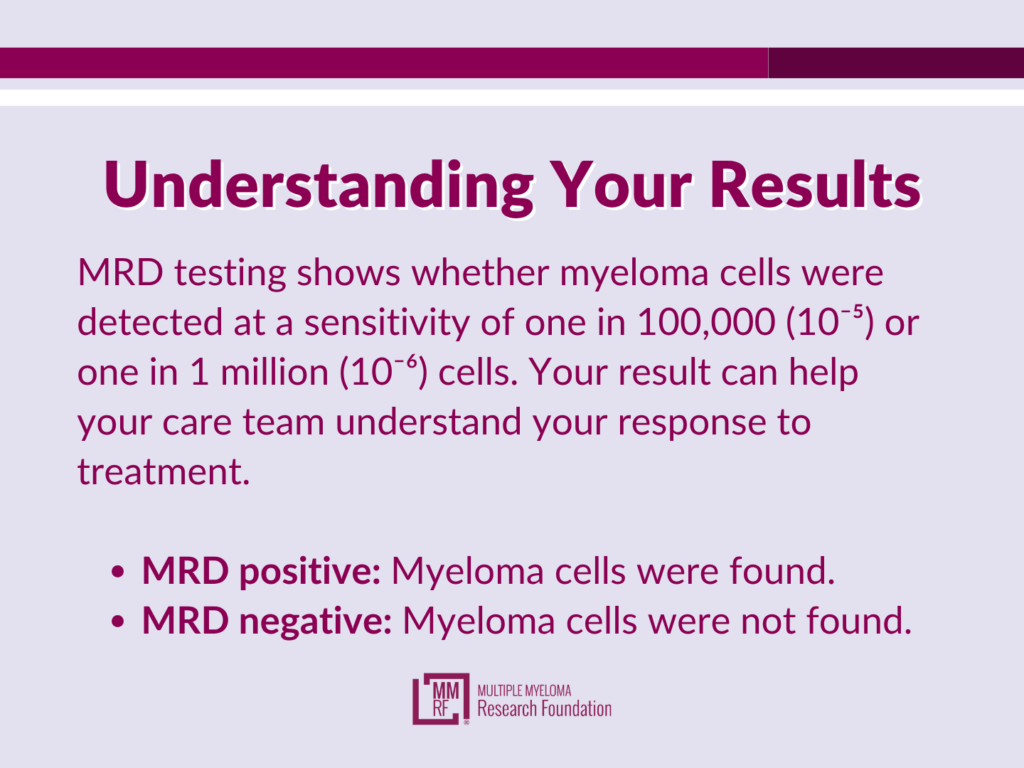
MRD stands for minimal residual disease. It refers to the very small number of myeloma cells that can linger in your bone marrow after treatment. A person can be in complete remission based on standard tests and still have myeloma cells that those tests cannot detect. MRD testing is more sensitive than other standard tests. It can detect as few as a single myeloma cell among one million healthy cells.
“With MRD testing, we’re looking to see if there is any myeloma remaining in your body now that we’ve finished your initial treatment,” said MMRF Patient Navigator Grace Allison, RN, BSN, OCN, LIONs who worked as an oncology nurse for years before joining the MMRF Patient Navigation Center in 2020.
MRD testing for myeloma typically requires a bone marrow biopsy, although new technologies are being developed to potentially use blood samples in the future. Doctors analyze cells from the sample using highly sensitive tests to look for myeloma that may not show up in other tests. The result gives your care team one more piece of information they can use to track the progress of the disease.
Learn more about MRD in our Guide to Minimal Residual Disease in Myeloma.
How MRD is used in myeloma
MRD can be used as a tool to assess how well your disease has responded to treatment, typically after one line of treatment. In clinical trials, it’s used to evaluate the potential of new therapies. It is also being used in the field’s new working definition of a cure: Patients who are MRD-negative and have been off all anti-myeloma therapy for five years may be considered cured.
“In the United States, there’s a day-100 testing after a stem cell transplant, where doctors repeat a bone marrow biopsy and run blood tests to measure their disease response,” Allison explained. “So that’s generally when patients would hear about MRD.”
MRD test results give your care team another way to monitor your disease. MRD negative means that no myeloma cells were detected in the sample in highly sensitive testing. At its most sensitive (10⁻⁶), it would be the equivalent of searching through a pile of one million pennies to find one with a specific defect.
So hearing that you’re MRD negative at this level of sensitivity can be encouraging news and suggests that you may have experienced a deep response to treatment.
“MRD negativity is associated with progression-free survival, or a longer time free of disease that needs treatment,” Allison said.
While MRD negative status is a good sign, it’s not a guarantee that the disease won’t return. Even patients who remain MRD negative for 12 or 24 months can relapse, so it’s important to continue monitoring the disease.
However, a prolonged period of MRD negativity is associated with a lower likelihood of disease progression, especially for people with high-risk myeloma. This is called sustained MRD negativity. The longer that lasts, the better a patient’s outlook.
Sustained MRD negativity may also help guide future treatment decisions. In some cases, doctors are beginning to consider it in conjunction with other factors, such as a patient’s risk level, when deciding to potentially stop maintenance therapy. However, researchers are still studying how MRD results should impact treatment decisions. You should always discuss what your results imply with your care team.
If results show you’re MRD positive, it means that the test detected myeloma cells in your bone marrow sample. While this news can feel discouraging, it doesn’t necessarily mean your treatment didn’t work or that you’ve relapsed. You can achieve remission even while MRD positive, and some people have residual disease that remains stable over time. That’s why care teams look at trends over several years, not just after a single MRD result.
“You may have residual disease, you may be MRD positive, but we’re going to keep measuring that,” Allison explained. “And then if it stays stable, it may mean you’re in remission.”
MRD testing also has limitations. Because myeloma can occur in patches throughout the bone marrow, a biopsy only shows what’s happening in the spot where the sample was taken. “It’s just one snapshot of the marrow in that spot,” Allison said. To account for that, doctors often pair MRD testing with imaging, such as a PET scan, to look for active disease elsewhere in the body.
How patients can feel empowered by disease monitoring
MRD testing isn’t available to all myeloma patients yet. It requires access to specialized testing that is only available at some treatment centers (primarily academic medical centers). Fortunately, it’s just one of several ways to track how myeloma is progressing and responding to treatment.
“The way I explain it to patients is that we do all these tests and put the results together like a jigsaw puzzle,” Allison said. “We get our PET scan, we get our bone marrow biopsy, we get a blood test, and then that is the picture of your particular disease.”
You can help put that puzzle together with your care team. Here’s how:
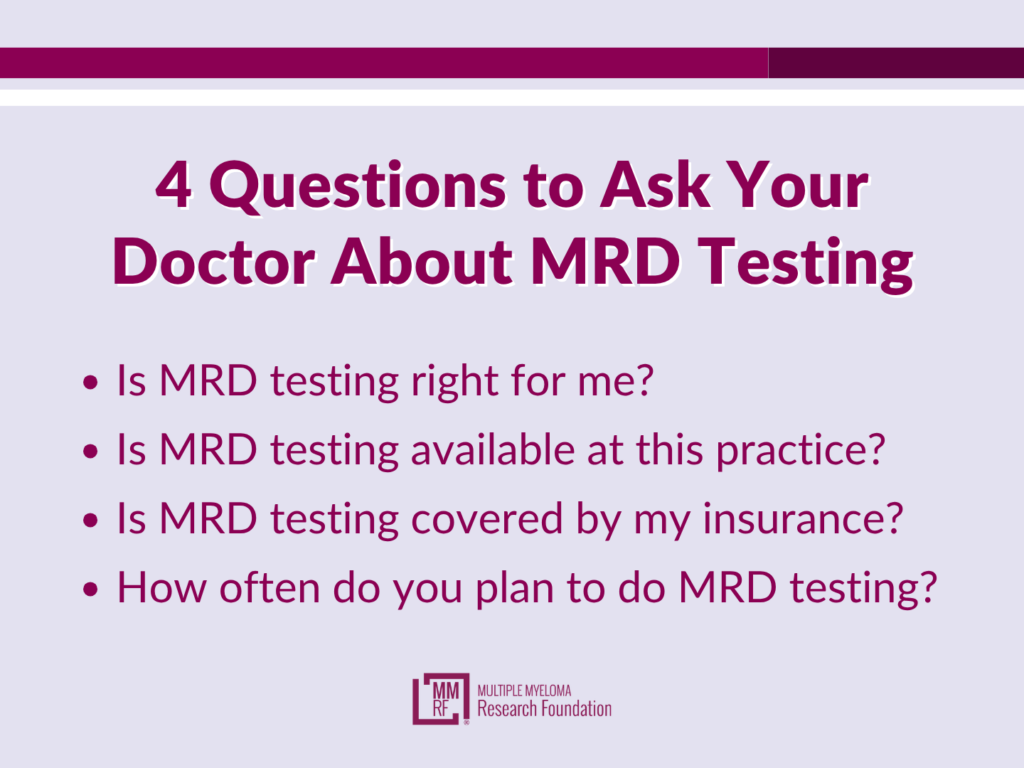
- Start by asking your doctor whether MRD testing is appropriate for you, when the testing should take place, and how the results may affect decisions about your care. If your doctor is planning a bone marrow biopsy, Allison recommends asking what tests will be performed on the sample and whether MRD testing is among them.
- If you see both a local hematologist-oncologist and a myeloma specialist, ask how the two can share test results and monitor your disease together. Keeping your entire care team up to date can give each doctor a complete picture of how your myeloma is changing.
- If MRD testing isn’t available, get clarity from your care team about their plan to monitor your myeloma. They can use blood tests that track myeloma markers. “We didn’t always have MRD tests, but we still monitored patients by checking their M-spike, free light chain numbers, kidney function, and their complete blood count,” said Allison.
- Ask your care team about symptoms you should watch out for. “Tell your physician about any new pain in your hip or back,” Allison noted. “It might be unrelated, but they can investigate it to make sure there are no lesions popping up.”
Remember: The goal of treatment isn’t to get a result on one particular test. It’s to control your disease and improve your quality of life over the long haul.
“Don’t focus just on one number from one test—keep the big picture in mind,” said Allison.
Whether or not MRD is part of your care right now, understanding how your myeloma is monitored can help you ask the right questions and feel more prepared for the next steps. Staying on top of how you feel and speaking up about new symptoms gives your care team one more important piece of the puzzle as they watch your myeloma over time.
Common questions about MRD in multiple myeloma
What does MRD mean in multiple myeloma?
Minimal residual disease (MRD) refers to the small number of myeloma cells left in the bone marrow after treatment, even when other tests no longer detect signs of the disease. Highly sensitive MRD tests can detect as few as one myeloma cell out of one million cells.
What does it mean to be MRD negative?
Being MRD negative means that an MRD test did not detect any myeloma cells in the sample your care team collected. This is generally a sign that treatment has worked well, but it does not mean that the disease is cured. Sustained MRD negativity is especially encouraging and may help guide decisions around maintenance therapy.
Is MRD testing standard for multiple myeloma patients?
While MRD testing is a helpful tool for assessing treatment response, it may not be available for every multiple myeloma patient. Many doctors continue to rely on standard monitoring methods, such as bloodwork and imaging, that patients can be assured are effective.
When is MRD tested during multiple myeloma treatment?
MRD is most commonly tested after first-line treatment such as stem cell transplant or induction therapy for patients who don’t have a transplant. Your care team may repeat MRD testing regularly to track changes in your disease. How often you’re tested depends on your results and individual treatment plan. MRD testing is also used to assess treatments in clinical trials.
Should I ask my doctor about MRD?
Yes. Asking your doctor about MRD can help you understand whether testing makes sense for you and what the results could mean about your treatment response. If MRD testing isn’t recommended or available, ask how your care team will monitor your myeloma and what changes they’ll watch for over time.
What happens if I’m MRD positive after treatment?
Being MRD positive means the test detected the presence of myeloma cells, but it doesn’t necessarily mean your treatment didn’t work. Many people with standard-risk disease who remain MRD positive still have very good outcomes. Your care team will consider your MRD result along with other factors to determine how to monitor your disease and whether your treatment should change.
Does MRD negativity mean I’m cured?
No. MRD negativity means that no myeloma cells were detected in your sample, but it does not guarantee that all cancer cells have been eliminated. Some people who are MRD negative eventually relapse. However, the longer you maintain MRD negative, the lower your risk of the myeloma returning.